Complete Guide to Mortgages for the Self-Employed in Canada
- Norbert Olejnik

- Jan 6
- 5 min read
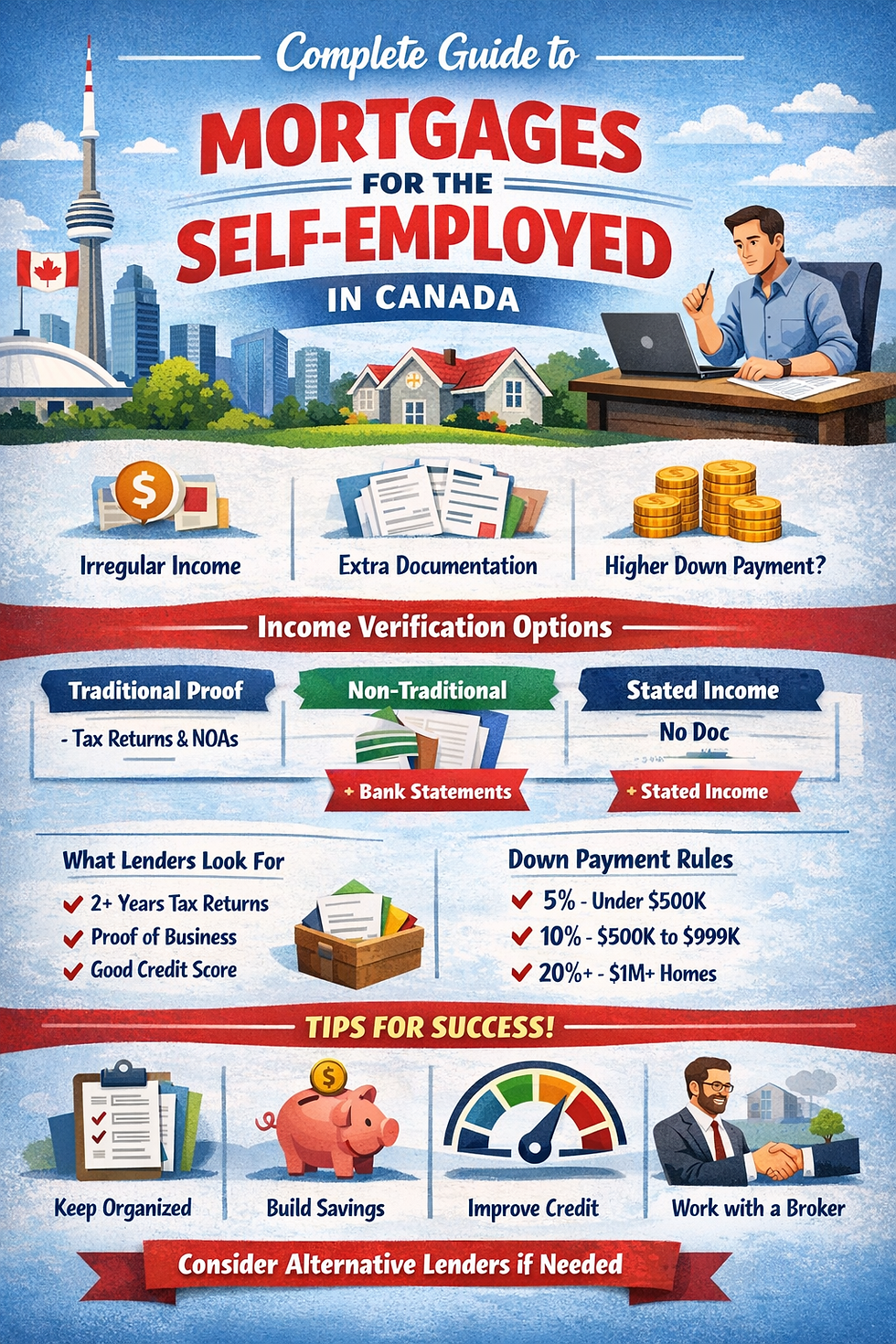
Being self-employed gives you freedom, flexibility, and control over your income — but when it comes time to apply for a mortgage, that same flexibility can feel like a disadvantage.
If you’ve ever been told “come back when you have two years of T4s” or felt your real income wasn’t being recognized, this guide is for you.
This is your complete, step-by-step guide to getting a mortgage in Canada as a self-employed borrower — including how lenders really assess your income, what documents you need, common mistakes to avoid, and the best mortgage options available today.
Table of Contents
Why Mortgages Are Different for the Self-Employed
Who Counts as Self-Employed?
How Lenders Assess Self-Employed Income
Mortgage Options for the Self-Employed
Required Documents Checklist
How to Improve Your Approval Odds
Common Myths About Self-Employed Mortgages
First-Time Buyers vs. Business Owners
Refinancing & Renewals When Self-Employed
Working With a Mortgage Broker
Frequently Asked Questions
Final Thoughts
1. Why Mortgages Are Different for the Self-Employed
Traditional employees have it easy: lenders look at their T4 and recent pay stubs. Self-employed borrowers? Not so much.
Lenders care about:
Stability
Consistency
Provable income
Because business owners often:
Write off expenses
Pay themselves irregularly
Reinvest profits
Use dividends instead of salary
…your taxable income may look much lower than what you actually earn — and that’s where most mortgage applications run into trouble.
2. Who Counts as Self-Employed?
You’re considered self-employed if you are:
A sole proprietor
A corporation owner (even if you pay yourself a salary)
A contractor or freelancer
Commission-based with no guaranteed income
Gig workers (Uber, DoorDash, etc.)
Professional service providers (realtors, consultants, trades, etc.)
Even if you receive a T4 from your own corporation, most lenders still treat you as self-employed.
3. How Lenders Assess Self-Employed Income
There are three main ways lenders evaluate income:
1️⃣ Traditional (Prime) Lending
Banks use:
Last 2 years of personal tax returns
Line 15000 income
Business financials (if incorporated)
They usually average the last two years and want to see stable or increasing income.
2️⃣ Stated Income Programs
Available through:
Alternative (“B”) lenders
Some credit unions
Certain monoline lenders
Here, lenders look at:
Your industry
Your business bank statements
Your lifestyle and cash flow
Reasonable income estimates
This is ideal for business owners who write off a lot of expenses.
3️⃣ Bank Statement Programs
Some lenders allow:
6–12 months of business bank statements
Income is calculated based on deposits instead of tax returns
Great for:
Newer businesses
Cash-heavy industries
Seasonal earners
4. Mortgage Options for the Self-Employed
You’re not limited to just one path.
Prime Lenders (Big Banks & Monolines)
Best if you have:
Strong credit (680+)
Two years of solid income
Low debt ratios
Alternative (“B”) Lenders
Perfect for:
Business owners with write-offs
Inconsistent income
Short time in business (1–2 years)
Rates are slightly higher, but:
Approval is easier
Flexibility is greater
Often a stepping stone back to prime later
Private Lenders
Used when:
Credit is bruised
Income is hard to prove
Property value is strong
Short-term solution only — but can be a powerful strategy when used correctly.
5. Required Documents Checklist
While it varies by lender, expect some or all of the following:
Personal
Government ID
Credit report
Recent bank statements
Personal tax returns (2 years)
Notices of Assessment
Business
T1 Generals or T2s
Business financial statements
Articles of incorporation
Business license
GST/HST filings
Business bank statements
A good broker will tell you exactly what you need based on the lender path — not overwhelm you with everything.
6. How to Improve Your Approval Odds
Here’s what really moves the needle:
✅ Keep Personal Credit Strong
Pay bills on time, avoid maxing cards.
✅ Reduce Consumer Debt
Lower ratios = higher approval chances.
✅ Plan Ahead
Talk to a broker before tax season. Sometimes small tax-planning tweaks can mean a huge mortgage difference.
✅ Separate Business & Personal Finances
Clean financials build lender confidence.
✅ Work With a Specialist
Not all mortgage brokers understand self-employed files — this matters more than rate alone.
7. Common Myths About Self-Employed Mortgages
Myth #1: You need 20% down→ False. You can buy with as little as 5% down in many cases.
Myth #2: You need two full years in business→ Often true for banks — but alternatives can approve with 12 months or even less.
Myth #3: You’ll always pay higher rates→ Not necessarily. Many self-employed borrowers qualify for prime rates with the right structure.
Myth #4: You should claim more income just to get approved→ Dangerous. There are better strategies that don’t involve tax risk.
8. First-Time Buyers vs Business Owners
First-Time Self-Employed Buyers
Often struggle with:
Short business history
Smaller down payment
But benefit from:
Insured mortgage programs
Stated income options
First-Time Buyer incentives
Established Business Owners
More flexibility:
Equity options
Refinancing
Cash-out for investments
Can leverage:
Corporate income
Multiple properties
Portfolio strategies
9. Refinancing & Renewals When Self-Employed
Even if you already own a home, being self-employed matters at:
Renewal
Switching lenders may require full re-qualification.
Your income situation today matters — not five years ago.
Refinancing
Pulling equity for:
Business expansion
Debt consolidation
Investments
Often easier than a purchase because of:
Existing equity
Payment history
10. Why Working With a Mortgage Broker Matters
Banks have one box. Brokers have many solutions.
A broker who specializes in self-employed mortgages will:
Match your file to the right lender
Structure your income correctly
Save you time, stress, and rejections
Often get you approved when banks say no
The difference isn’t just approval — it’s approval on the best possible terms.
11. Frequently Asked Questions
Can I get a mortgage if I just became self-employed?
Yes. Some lenders accept as little as 6–12 months of business history depending on your industry and background.
What credit score do I need?
Prime lenders: usually 680+
Alternative lenders: 600+
Private lenders: case-by-case
Can I use corporate income?
Yes — many lenders will consider:
Salary
Dividends
Retained earnings
Gross business revenue (with programs designed for this)
Can I buy with less than 20% down?
Absolutely. Many self-employed borrowers buy with 5–10% down using insured or alternative programs.
12. In Conclusion
Being self-employed should not stop you from owning a home, growing your wealth, or refinancing strategically.
You just need:
The right strategy
The right lender
The right advisor
Mortgages for the self-employed aren’t harder — they’re just different. And when done correctly, they can be just as competitive as any traditional mortgage.
Your Business Is Unique — Your Mortgage Should Be Too
I specialize in helping self-employed Canadians:
Buy their first home
Move up
Refinance
Renew smarter
Access equity for business or investments
You don’t need to fit the bank’s box — you just need the right strategy.
👉 Book Your Free Self-Employed Mortgage Consultation
Norbert Olejnik Mortgage Specialist | Dream Key Mortgage📧 Norbert@dreamkeymortgage.ca


